Thursday, May 16, 2024

Fredricks Vaudeville Stage Show

August Bert Fredrick was the half-brother of my husband’s great-grandmother, Bozana Fridrich Svejkovsky. He was born on the 31st of August 1883. His 1907 marriage license names his parents as, “Jas Pessick and Frances F Fredrick”.  It is uncertain whether his parents were ever married. I became interested in AB Fredrick’s story when I learned he was a “vaudevillian”. Searching the traditional family resources, along with newspapers and Billboard magazine opened up his story.


In 1946 Anna Stransky sent a letter to her cousin Bill Svejkovsky in Oklahoma. She shared some family news and mentioned her Uncle August and his family, who she had hardly known - “. .  the last time we heard of them they were traveling with a Circus side-show.” Family members were surprised that August had gone into “that sort of life.” In the early twentieth century, when August Fredrick was beginning his family, he operated a postal route near Geddes South Dakota. But, the 1930s and 40s found he, his wife Vera, and his two children Carlyle and Maxine, caught up in the Show Business life.

The Fredrick family may have begun this new life by “joining the circus”. They capitalized on their various talents by forming a sort of family group.  They made their home-base in Houston Texas and travelled primarily in Texas. August Fredrick was both a performer and promoter; his wife Vera Frush Fredrick was a magician; son Carlyle Fredrick a musician; and daughter Maxine Fredrick an aerial artist.

1932 City Directory of Houston Texas
Aug B Fredrick (Vera M); Orient Ball Room, manager
Carlisle M Fredrick; Musical Fredricks Novelty Band, director
Maxine, Miss; musician; Musical Fredricks Novelty Band
Musical Fredricks Novelty Band; home 5400 Harrisburg Blvd

Billboard (magazine) was founded in Cincinnati as a trade publication for men who posted “bills” on walls. From its first issue in 1894, Billboard covered the entertainment industry, such as circuses, fairs and burlesque shows, and also created a mail service for traveling entertainers.  August Frederick and his family used the Billboard mail service, and occasionally purchased promotion ads.

AB Fredrick circus unit has signed with Rice Brothers. It consists of musical act; Madam VeOra, magic and illusions; Major Dot, midget for Side Show; Maxine Fredrick, tight wire and rings; and Fredrick's trained dogs for big show. Will leave for Jackson Tennessee.
The Billboard, 21 March 1936.

In 1943 the family matriarch, Vera Frush Fredrick, died. She was remembered with a brief obituary and a memorial statement in Billboard.  

Vera M Frederick, 53, known as Madam Ve_Ara, magician, at Memorial Hospital. Houston, October 22 following a long illness. She formerly toured with the Frederick Vaudeville Playhouse tent show. Survived by her husband AB Frederick; a daughter Maxine, aerial artist; a son Carlyle, for the musical act, Fayne and Foster; and a foster son Louis L Stice, in the armed service. Interment in Brookside Memorial Park, Houston.
The Billboard, 13 November 1943.

In Memory of Our Dearly Beloved Wife and Mother “Madam Ve-Ara” Who passed away 22 October 1943. Husband – AB Fredrick, son – Carlyle I Fredrick, daughter – Maxine C Fredrick.
The Billboard, 4 November 1944.

Following Vera’s death the family forged on, placing occasional ads in Billboard’s magazine through the 1940’s.    

Wanted at Once; Team or family with specialities, anything suitable for three night stand vaudeville Tent Show. Established Texas territory. Long season; AB Fredrick, 4845 Yale Street, Houston Texas.
The Billboard, 5 April 1947.

Wanted - Single or Team doing two or more spots for Fredricks vaudeville stage show (tent), little spots, short jumps, two and three night stands. Texas only, long season. AB Fredrick, 302 Payne St, Houston Texas.
The Billboard, 16 April 1949.

The great depression years signaled a slow demise for the canvas playhouses of the Midwest. Vaudeville disappeared and the small circus began a decline.  Radio shows kept people at home, and after WWII, television and air-conditioning held sway.  Carlyle Fredrick married Mary Pearl Dozier in 1934. Maxine Fredrick married her ‘foster brother’ Louis Stice in 1946. There is no evidence that either had children. August Burt Fredrick died in 1967.  His obituary describes him as “retired entertainer and operator of a local trailer park”. He is buried with his wife Vera at Brookside Memorial Park in Houston.


Would you like to know more?

Tent Shows, by Randy Mallory, December 2018.
At the turn of the 20th century, traveling circuses and repertory theaters brought live shows to the Texas countryside. Blog Post appearing at the Sam Houston Electric Cooperative website.

About the Photo:
Trapeze Artist, by James Lechay, 1940; Smithsonian American Art Museum.

Sunday, August 13, 2023

Andrew Albert Burr and WWI Field Hospitals

In 1917, at the age of 23, Andrew Burr signed up for the draft, and set out for service in WWI.  His records indicate that he served as a private for Field Hospital Co No 12.  It has been a challenge to determine exactly where he was during the War, but company histories suggest that he worked with a medical unit that was eventually established at Bonvillers in Northern France. He could have performed a variety of jobs such as ambulance driver, stretcher bearer, surgical assistant, cook, or cleaning crew. No detailed records for Andrew Burr’s particular role have been found. 

The term Field Hospital covers several types of medical units that were set up near the front lines of the war.  These were generally the places where wounded soldiers went for triage (assessment) and stabilization of wounds before transport. After triage, they were taken by ambulance to the evacuation hospitals. The Field Hospital Co No 12 moved about to different locations during the war and served both as a triage location and an evacuation hospital. 


On the 22nd of April 1918, Field Hospital No. 12 opened in a large chateau in Bonvillers. It treated the most severe and non-transportable wounded, of whom it admitted 1,220 between April and July 1918. At some point (unclear) the medical operations at Bonvillers were referred to as an American Base Hospital, where surgeries and longer term care was offered.

An internet search turned up an amazing, first-hand video of the medical support provided at Bonvilliers during WWI. Very interesting! Under the topic of WWI Field Hospitals, the description reads - Raw footage of ambulances, medical men and nurses around tents; soldiers walking past other large medical tents on large estate grounds at Bonvillers, Picardie [France].

As mentioned above, no detailed records of Andrew Burr’s type of work have been found.  The University of Kansas Medical Center presents an interesting collection of articles on their website related to the establishment and daily work of American Base Hospital No 28 in Limoges, France during WWI.  A few details from these articles might serve to “frame a picture” of what Andrew Burr was connected with during the war. 

During stateside training non-medical enlisted men received training in treatment of shock, injuries from poison gas, limb amputation, identification and removal of shell fragments, and reconstructive surgery.

The American military set up base hospital clusters located from 50 to 200 miles from the front.  The rhythm of the hospitals was largely determined by the arrival of ambulance trains from the front.

On 27 July an ambulance train with 600 wounded and sick soldiers arrived at Base Hospital #28 at 9:30 PM. In spite of the hospital station platform being dark, Dr. Hibbard and all available staff triaged patients quickly and by 3:00 AM all patients, including some with very serious wounds, were in appropriate wards in their beds. The process of "renovation" as Captain Sherman Hibbard described it, was the transformation of filthy, louse-infested, weary, sick and wounded soldiers into clean patients with warm meals in their stomachs.

To accomplish this goal the effort and dedication of a huge support staff was needed.  This “unnamed” group included Andrew Burr, our ancestor.

Andrew Burr was demobilized in August of 1919. He departed from Brest in France and arrived back in the US at Hoboken New Jersey on the first of September 1919.  He was discharged from service on 24 Sept 1919 at Camp Dodge, Iowa. After his war service Andrew Burr spent some time with his family in Nebraska and then removed with his older brother Edward Burr to homestead in Wyoming.


For more details on Andrew Albert Burr, visit his page at the Family Stories website.


Further Reading:

WWI Field Hospitals. 221694-07; Description:  Raw footage of ambulances, medical men and nurses around tents; soldiers walking past other large medical tents on large estate grounds at Bonvillers, Picardie [France]. 10 minutes.    https://www.youtube.com/watch?v=GS6ufYuRcWo

Medicine in the First World War; Base Hospital #28; University of Kansas Medical Center.


About the Photo: 

Chateau de Bonvillers (no date). United States Army Base Hospital No 12, Located at Bonvillers in Northern France.  Images from the History of Medicine; The National Library of Medicine believes this item to be in the public domain.


Moving back in time:  Kevin Andrew Germann 1978 > Gary Germann 1958 > Elsie Josephine Burr 1930 > Andrew Albert Burr 1894.

Andrew Albert Burr is the great-grandfather of my son-in-law, Kevin Andrew Germann.


Thursday, January 20, 2022

Whitchurch Connections to the Past

For many years I have been aware of a tradition among Whitchurch descendants, that their Whitchurch ancestor was “the first printer of the King James Version of the Bible”.  Like many family traditions (myths) there are elements of truth, coupled with suspect interpretations.  In a previous blog post I took a look at Edward Whitchurch (c.1500-1561), printer of the Great Bible.  A period of more than one hundred and fifty years passes between  Edward Whitchurch, the sixteenth century English printer, and Thomas Gilbert Whitchurch who appears in late eighteenth century America, residing in New York.  This blog post looks at a few clues that could eventually provide an ancestral pathway connecting the two men. The path is tenuous at best.  Hopefully future work will reveal more.  Pam Garrett, 2021.

Edward Whitchurch lived during the first half of the sixteenth century, in the reigns of the English King Henry VIII and his progeny.  He was a prominent printer of London, and was noted for his enthusiastic support of the reforming protestant movement of his age, and for making available the Great Bible. Researchers record four children for Edward Whitchurch, three daughters and one son – Edward Whitchurch jr.  Beyond his name, no clear evidence has surfaced to define this younger Edward Whitchurch.

A large family of Whitchurchs were established at Frome in Somersetshire by the beginning of the seventeenth century. A significant collection of documents reflect that they were successfully pursuing the merchant, and related trades, of the period.  They appear on a list of men licensed to trade in Virginia tobacco (1634), and have connections to the East India Company.  A 1681 Will for William Whitchurch of Somersetshire establishes a group of brothers - William, Edward, James, Samuel, and Leonard Whitchurch.

A brief biography of James Whitchurch, Apothecary, living during the mid-1600’s, identifies him as the son of Samuel Whitchurch of Frome, “one of a prominent family of mercers, drapers and salters.” He left quite an amazing Will and codicil in 1692, highlighting his activities and possessions.  


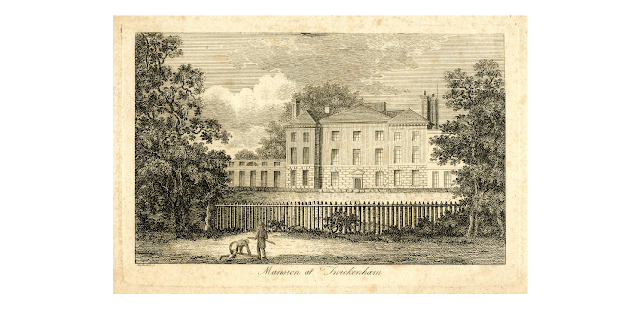
Another curious player in the Whitchurch family story is James Whitchurch (1703-1786) of York House in Twickenham, London.  He is a descendant of the Whitchurchs at Frome in Somersetshire; a grandson of James Whitchurch, Apothecary. His business connections were extensive, and included trade in Virginia. He and his wife, Mary Rust, purchased York House in Twickenham about 1746, and it remained the Whitchurch home for almost forty years.  Mary predeceased her husband and died without issue.  James Whitchurch’s 1786 Will, with codicils, runs to fifteen pages, and introduces a broad spectrum of interesting people, connected by family, business and church. A mention of Matthew John Gilbert and his sister Elizabeth Gilbert in his Will, seemed worth pursuing.  But, there was nothing to suggest a connection between James Whitchurch of Twickenham and the Whitchurchs in America.

In the late years of the eighteenth century a man that Whitchurch researchers name as Thomas Gilbert Whitchurch shows up in New York City.  His wife is called Bethia, sometimes Bethia White, and he is noted as the ‘immigrant’ to America for a large family of Whitchurchs scattered throughout the United States today.  Evidence for Thomas Gilbert Whitchurch is scant. But, his likely children do present themselves more clearly – Thomas, John, Bethia, Mary, and William Whitchurch.

Descendants of Thomas Gilbert Whitchurch hold to the ‘Bible printing ancestor’ tradition. Hints and clues keep that story alive.  But, much further work needs to be done to strengthen the pathway.


For more details on Thomas Gilbert Whitchurch, visit his page at Family Stories, pamgarrett.com.

Further Reading:
Edward Whitchurch: Bible Printer; posted on the Family Stories Blog, 17 January 2022.
The Twickenham Museum website.  Places > Twickenham > York House

About the photo:
Mansion at Twickenham; print made by James Peller Malcom, 1782-1815; from the collection of the British Museum.  Note – The British Museum website gives the description “View of a large neo-classical villa . . “.  Other sources identify this illustration as “York House, 1808”.  A comparison with more recent photographs of York House in Twickenham suggests that they could be one in the same.  James Whitchurch lived at York House about 1746-1786.  


Moving back in time:  Otis Sylvester Garrett 1894 > Isaac Sylvester Garrett 1860 > Celia Whitchurch 1833 > William Whitchurch 1778 >Thomas Gilbert Whitchurch c.1750.
Thomas Gilbert Whitchurch is my husband’s 4xgreat-grandfather.

Monday, January 17, 2022

Edward Whitchurch – The Bible Printer

For many years I have been aware of a tradition among Whitchurch descendants, that their Whitchurch ancestor was “the first printer of the King James Version of the Bible”.  We need to consider a variation on this theme.  Over the years I have collected bits and pieces of information related to this story, but after a more considered study, I am beginning to get a clearer picture. The English printer who is being considered is Edward Whytchurch or Whitchurch, who lived about 1500 to 1561, primarily in London.  He was not connected with the King James Version of the Bible (printing begun in 1611).  He was most closely associated with the printing of the “Great Bible”.   Pam Garrett, 2021.

“Edward Whitchurch or Whytchurch (died 1561), protestant publisher, was a substantial citizen of London in the middle of Henry VIII’s reign.  His business was probably that of a grocer.  He accepted with enthusiasm the doctrines of the protestant reformation.  In 1537 he joined with his fellow citizen Richard Grafton in arranging for the distribution of printed copies of the Bible in English.”  
from – Edward Whitchurch’s biography published in England’s Dictionary of National Biography.


Whitchurch and Grafton worked together for a number of years printing Bibles in English and other protestant literature.  Their first printing efforts took place in France, but that shortly met with disapproval and they established their presses in England at the ‘House late of the Graye Freers’.  That is where the Great Bible was first published in April 1539.

In 1538, the English clergy was directed to provide "one book of the bible of the largest volume in English, and the same set up in some convenient place within the said church that ye have care of, whereas your parishioners may most commodiously resort to the same and read it."  This was the Great Bible, authorized by King Henry VIII, commissioned by Thomas Cromwell, prepared by Myles Coverdale, and printed by Whitchurch and Grafton.  Although called the Great Bible because of its large size, it is known by several other names as well; Cromwell Bible, Whitchurch’s Bible, and the Chained Bible, because it was chained to the church lectern to prevent removal.   

There are documents recognizing royal support for Edward Whitchurch’s printing efforts, but in 1543, following the fall of Thomas Cromwell, Whitchurch and Grafton, along with other printers, were committed to the Fleet prison for printing unlawful books.  They remained for several weeks, but then returned to their printing efforts.  

During Edward VI’s reign (1547-1553) Whitchurch was noted for a number of projects at the sign of the Sun on Fleet Street; including several further editions of the Great Bible, the Book of Common Prayer, primers for school children, and secular books on philosophy and medicine.  The accession of Catholic Queen Mary in late 1553 again brought trouble for Edward Whitchurch, and he determined to leave England.  

A man of wealth and influence, Edward Whitchurch, gave up much in England, before his flight to the continent, possibly to Germany or the Netherlands.  Some of his personal story can be uncovered by looking at the history of Merton Priory and neighboring Growtes Manor.

As a part of his scheme to establish an English Church, King Henry VIII dissolved many of his country’s Catholic institutions, including Merton Priory which resided in the beautiful district of Morden*.  The main priory building, a significant structure, was physically dismantled and the stones were used in the building of a nearby castle. In June of 1553 Edward Whitchurch had the opportunity to purchase Morden from King Edward VI, and he occupied a manor house, Growtes, on the extensive grounds. Sadly, he did not enjoy it for long.   

An article of interest, ‘Growtes: The Home of a Rich Man in 1554’, was written by David Haunton, and published in the Merton History Society Bulletin of December 2009.  Haunton introduces the article:

Edward Whitchurch sold the mansion house called ‘Growtes’, together with the lordship and manor of Morden and all his other lands, houses and rights in Morden, to the Garth family on 7 March 1554 . . for the sum of £460 (at least a million pounds today) . .  

The primary purpose of Haunton’s article is to look at the inventory attached to the Bargain and Sale document, and “explore the taste of a rich man in the mid sixteenth century”.  To that end, the article is very interesting.  But, for purposes here, Haunton’s work is helpful in giving some clues to Edward Whitchurch’s wives and children.  Evidence is scant, but it suggests that Edward Whitchurch was married two or three times.  His first wife remains unclear.  He may have had a wife named Agnes, who could have been the first wife, but was more likely to be second.  Haunton tells us Edward Whitchurch was, “survived by four adult children, presumably of his first marriage; Edward, Helen, Elizabeth and a third daughter whose name is unknown.”

About the year 1556, during his exile on the continent, Edward Whitchurch was married to Margaret, widow of the “tragic” Archbishop Thomas Cranmer. Cranmer was in long service to England’s King Henry VIII. During an early diplomatic mission on the continent Cranmer befriended Andreas Osiander, “leading architect of Nuremberg’s reformation movement”.  In short order, Thomas Cranmer had married Margaret, the niece of Osiander’s wife.  Margaret’s maiden name is not known.  Edward Whitchurch and Thomas Cranmer worked on a number of publishing projects together, and Whitchurch was known to be “Cranmer’s favorite printer”.  After Cranmer’s murder on the 21st of March 1556, the Whitchurch family made an effort to shield and protect his widow and children.   

Not long after Elizabeth came to England’s throne, 1558, Whitchurch returned to his English presses and completed several more projects before his death.  Evidence suggests that he is the “Maister Wychurch”, buried on the 1st of December 1561, at Camberwell in South London.

It is a challenge for today’s researchers to draw a connection between Edward Whitchurch, the sixteenth century English printer, and Thomas Whitchurch who appears in late eighteenth century America, residing in New York. Evidence for both men remains sparse.  Whitchurch family researchers have worked toward drawing a connection but no clear picture has emerged.  There are a few clues of interest.  Hopefully future work will reveal more.


*Today Morden is part of busy south London. Morden Hall Park, operated by the National Trust, is one hundred and twenty-five acres of parkland with the River Wandle running through it. Morden Hall, at the park’s center, was built by the Garth family in the 1770s.  Morden’s Tudor past, represented by Merton Priory, is the subject of an interesting archaeological study.  


Further Reading:
∙ Edward Whitchurch; Dictionary of National Biography, 1885-1900; Sidney Lee article.
∙ Edward Whitchurch; Alec Ryrie, 2008; published in Oxford Dictionary of National Biography.
∙ An Auncient Zelous Gospeller . . Desirous to Do Any Thing to Common Good: Edward Whitchurch and the Reformist Cause in Marian and Elizabethan England; Scott C Lucas; 2016.
∙ A Century of the English Book Trade: Short Notices of All Printers; E Gordon Duff; Cambridge, 2011.
∙ Growtes: The Home of a Rich Man in 1554; David Haunton; published by Merton Historical Society, Bulletin 172, December 2009. Available online at the Merton Historical Society website.
∙ Merton Historical Society website.  Excellent!
∙ Merton Priory - History Unearthed; sixteen minute documentary film on UTube. Also Excellent!

About the photo:
Title page from The Byble in English (The Great Bible), prynted by Richard Grafton and Edward Whitchurch, 1539; located through wikimedia commons.

Wednesday, December 22, 2021

The Whitchurch Family at Silver Creek

St Clair County Illinois rests in the southwestern part of the state and includes the towns of Belleville and Mascoutah.  It borders with the state of Missouri, and the famous prairie town of St Louis-East St Louis, which straddles the border, is within twenty miles of Belleville Illinois.  St Clair County’s earliest form of government divided the county into precincts, but later used the township system.  The Whitchurch farms were located about equidistant from the small St Clair communities of Freeburg and Fayetteville. 


 A description of the area in a St Clair County history, gives detail:

 . . Silver creek, which enters the township on its northern boundary, flows a southerly course, emptying into the Kaskaskia; tributaries furnish water for stock and other purposes. The streams are skirted with a fine growth of timber. The surface is gently undulating, with considerable stretches of rich prairie. The noted Tamarois prairie . . lies partially in this township. The soil is well adapted to all cereals, and produces abundant crops.

Some of the earliest surveys and land grants to immigrant settlers were taken out around the turn of the century.  Family names included Teter, Mitchell, Shook, Griffen, Biggs, Rutherford and Edgar.  By 1814, public domain lands were being purchased from the federal government.  These early purchasers included – James Adams, Matthew Atchison, Pierre Menard, *David Howell, William McIntosh, Samuel Griffith, G Hendricks (to Stephen Whiteside), Samuel Mitchell, William Goings, Thomas Pulliam and Daniel Stookey.

It is not clear exactly when William Whitchurch arrived in the area.  According to family history, William Whitchurch was born in New York City in 1778, and he was married to Elizabeth Howell in 1801 in Knox county Tennessee.  The first record of note in Illinois is when William Whitchurch appears in the 1820 Census, placing him near the Silver Creek “settlement” in St Clair county.  It seems likely that he came to the area about 1815, around the time that *David W Howell, his brother-in-law, purchased, “. . 160 acres, being the NE quarter section 25, April 27th, 1815.“

William Whitchurch was married three times. He was first married to Elizabeth Howell, with whom he had nine identified children.  After her death he was married to Celia Carr in 1824, St Clair county Illinois.  William and Celia had four children.  His final, brief marriage was to Sarah (maiden name unknown).  Sarah was the widow of a Mister Herrin and brought three Herrin children into her marriage with William Whitchurch in June of 1848.  William Whitchurch died three months later, in September 1848.

William Whitchurch and his son built a mill in 1828.  The county history tells us, “. . They did all the work themselves, except the blacksmithing. The stone, which they dressed themselves, was found in David Pulliam’s branch, about three miles south-east of FayettevilIe. It was a round rock about 5 feet in diameter. It was claimed by millers to be equal to any French burrstone. By changing teams, the mill would turn out seventy-five bushels per day. Oxen were mostly used in grinding . . . “

On 21 March 1811, seven families organized the Silver Creek Baptist Church. They met in homes until 1817, when a log church was built.  The church was constituted on the Bible of the Old and New Testament, and stated a stand against slavery.  Members of the Whitchurch family participated in the life of the Silver Creek Church. The deaths of William Whitchurch’s second wife, and two sons appear in the records:  Celia Whitchurch in November 1845, Wessel Whitchurch in January 1849, and James [White] Whitchurch in Nov 1852.

Today the Old Silver Creek church is gone. Families joined with the congregations of Freeburg, Fayetteville and Mascoutah.  An 1863 township map for St Clair County, shows William Whitchurch’s son Gilbert Whitchurch still in possession of the family farms along Silver Creek.  But, by 1870 Gilbert had moved on to Dekalb County Missouri.  A number of Whitchurch descendants remained in the Silver Creek area well into the twentieth century.


*The History of St Clair County Illinois refers to the early settler of the NE corner of section 25 as Daniel Howell.  But, a review of the land records confirms that it was David W Howell.  


Sources:
History of St Clair County, Vol 2; Wilderman, 1907.
St Clair County History; Brink, McDonough and Co, 1881.
Freeburg Centennial Booklet, 1859-1959; available online.


For more details on William Whitchurch, visit his page at Family Stories, pamgarrett.com.

About the photo:
Turkey Hill Farm; from History of St Clair County Illinois; Brink, McDonough and Co, 1881.

Moving back in time:  Otis Sylvester Garrett 1894 > Isaac Sylvester Garrett 1860 > Celia Whitchurch 1833 > William Whitchurch 1778.
William Whitchurch is my husband’s 3xgreat-grandfather.

Monday, December 6, 2021

Lippe Detmold: German Homeland of the Biesemeier Family

Our Biesemeier ancestors were settled in the Principality of Lippe by the 1600’s.  Many Biesemeier births, marriages, and deaths appear in the Evangelical church records at Horn and Bosingfeld beginning in the late 1600’s.  


Lippe is a small but ancient region in northwestern Germany.  It is located between the Weser River and the Teutonburg forest. On a modern map you would find it about 200 miles north of Frankfurt and 180 miles east of Amsterdam.  Originally included in the duchy of Saxony, Lippe became a lordship in the twelfth century and a county in 1529.  By the 1700’s Lippe was a principality of the Holy Roman Empire.  As Lippe underwent several divisions, the area where the Biesemeier family lived became known as Lippe-Detmold.  Detmold was the largest town in the area. By 1815, Lippe was a member of the German Confederation.  Today Lippe is part of the state of North Rhine - Westphalia.  

Cord Biesemeier was probably born between 1780-1790 in the Lippe region.  Some researchers record his birth in the year 1771 in Stumpenhagan (Bega) in Lippe Detmold, but this seems early. His marriage to Wilhelmine Ellerbrock is recorded in the town of Horn, Lippe Detmold in 1818.  

From his 1818 marriage agreement we learn that Cord Biesemeier is a Kotter – a farmer or cottager, who rents his land.  And, that he and his bride will be living on, and operating the Biesemeier farm at number 18 in Leopoldthal.  His father, Friederich Biesemeier will continue to operate half of the farm, until he goes into retirement.  His bride, daughter of Johann Ellerbrock, hails from Frommhausen number 18.  

The towns of Horn, Leopoldstatt (Leopoldthal), Stumpenhagen (Bega), and Fromhausen are all listed as historic towns of Lippe Detmold.  Horn is the largest, and today adjoins the town of Bad Meinberg, an early spa location.  All of these towns lay within about a 15 mile radius of the city of Detmold.

In the mid-nineteenth century, the farms of Lippe were clustered together in hamlets. The land belonged to the nobility and was leased to tenant farmers. Farms tended to stay in the hands of one family for generations, most often passing to the oldest son, but occasionally being divided for use by the next generation. Families tended to be relatively small and not all the children married.

The valleys of the Lippe region sport good amounts of arable land and supported numerous small, but prosperous, peasant farmers. The climate is considered mild and agreeable.  This allowed for the raising of grains, beans, tobacco, and a variety of vegetables and fruits. Apple wine and plum brandy were popular in the area.  Dairy products abounded and the Lippe families raised horned cattle, pigs, sheep, goats and fowl.  Game hunting and fishing provided further protein.  

Researcher Maggie Blanck includes this delightful description of typical farm buildings in 1865, northern Germany.  It comes from an article titled, The Sacristan’s Household, published in Anthony Trollope’s Saint Paul Magazine:  

The whole centre of the building is a large and lofty barn, piled high with hay and straw and store of grain. It is, too, a storehouse for farm implements, and so huge are its proportions, that a harvest waggon laden with sheaves, and drawn by three or four sturdy horses, can pass easily through the doorway, and stand beneath its ample shelter. From the barn, which entirely occupies the central length and breadth of the building, is the only possible ingress to the dwelling-house. On the right hand and on the left are doors and windows giving access to the living and sleeping rooms of the family. Nearly all the light and air which reaches these apartments gains admission through the wide-open double doors of the barn . .  

Interesting studies of German House Inscriptions (Hausinschriften) have been helpful to family historians. In certain rural regions of the German-speaking world they were part of the cultural tradition and custom for many centuries. They were often carved into wooden beams of half-timbered houses, but are also found over driveways and entrances. Several inscriptions related to the Biesemeier family appear in the Lippe region.  One of particular interest was located in Leopoldstal, number 3 Kuhlmanns.  It represents the household of Johan Biesemeier and Frederica Kuhlman.  Johan is a possible brother of Cord Biesemeier. The German inscription reads:

ES IST O GOTT DEIN WILLE DAS BAUEN NUR AUF ERDEN DU GIEBST DEINEN KINDERN BROD UND WOHNUNG HIER AUF ERDEN
JOHAN BERNHARD BIESEMEIER AUS DEN LEPPOLDSDAHL FRIEDERIKE KUHLEMANS DASELBST DEN 5. JULIUS 1810 M.T.S.P

English:
It is O God your will to build only on earth, you give your children bread and accommodation here on earth; Johan Bernhard Biesemeier from Leopoldstal, Friederike Kuhleman, this is 5 July 1810.
 

For more details on Cord Biesemeier, visit his page at Family Stories, pamgarrett.com.

Further Reading:
LWL Open Air Museum at Detmold;  lwl-freilichtmuseum-detmold.de/en/
Lippe Detmold DE; Geographical DNA Project for the area now known as Lippe, North Rhein-Westphalia;
https://www.familytreedna.com/groups/lippe-detmold-de/about/background
Maggie Blanck Website; http://www.maggieblanck.com/index.html
Der Genealogische Abend: Naturwissenschaftlicher und Historischer Verein für das Land Lippe [Genealogy: Scientific and Historical Association for the state of Lippe]; http://nhv-ahnenforschung.de/

About the photo:
The district of Leopoldstal in Horn-Bad Meinberg, Lippe, North Rhein-Westphalia; shared by Grugerio, Aug 2014; Creative Commons.

Moving back in time:  Elba Josephine Hoffman 1898 > Josephine S Biesemeier 1866 > Rev William Biesemeier 1833 > Cord Biesemeier 1796.
Cord Biesemeier is my husband’s 3xgreat-grandfather.


Sunday, November 21, 2021

Richard White Hancock and the American Civil War

In April of 1862, when Dick Hancock was a few months short of his seventeenth birthday, he joined the Missouri State Militia, supporting the Union troops.  He was a member of the 6th Missouri Regiment, Company E, cavalry unit.  He inflated his age by a bit, in order to enlist.  The company Descriptive Book gives details:
 
Richard W Hancock; Co E, 6th Regt Mo State Militia Cavalry;  enlisted 12 April 1862 at Cameron Missouri by Capt Murphy for a term of 3 years; age 18; 5 feet 10 inches; fair complexion; blue eyes; dark hair; born Scott Kentucky; occupation farmer.


Richard White “Dick” Hancock was born in 1845 in Scott county Kentucky, one of the younger of Edward Hancock and Jemima White’s nine children.  About 1855 his family removed to Missouri, where the Hancock family lived for a number of years near the community of Victoria in Daviess County.  In the early years of America’s Civil War young Dick answered the call to serve with the Union.

Dick Hancock’s military “returns” show him serving in several different capacities through the war years.  In February of 1863 he was recorded as a hospital nurse, and in January 1864 he was “absent” doing recruiting service in Northwest Missouri.  Several returns listed him as “away for service in the field”.  By late 1864, during the months of November and December, he was working as a cook for the troops.  

The Missouri State Militia forces were authorized, subsidized, and equipped by the federal government.  Their primary activity remained within the state.  The war in Missouri was more of a local affair.  Union supporters were in the majority.  Confederate sympathizers and secessionists made guerilla style attacks on their neighbors.  Engaging these guerilla bands became the primary work of the State Militia.  After enlistment, Dick Hancock was stationed at Cameron Missouri, but within a short time the troops of the 6th Regiment began to move around the state.  In the Fall of 1862, “guerrilla bands of every size and description, sometimes operating in conjunction with small Confederate forces based in Arkansas, swarmed out of the woods and swamps and attacked towns and railroads, carried off horses and weapons, and killed Unionist civilians by the hundreds.”

The leaders of the State Militia began an effort to “starve out” the opposition by identifying the civilian population that provided food, shelter, horses, and new recruits.  Relatives and supporters of the guerillas were often fined or imprisoned; their properties and communities were sometimes put to the torch.  “This was a war of stealth and raid without a front, without formal organization, and with almost no division between the civilian and the warrior.”

Toward the close of the War the 6th Regiment was called to Westport (today a part of Kansas City).  The Battle of Westport occurred on the 23rd of October 1864, and is sometimes referred to as the “Gettysburg of the West”.  It is probably the only formal battlefield that Dick Hancock attended.  The Union forces of Major General Samuel R Curtis soundly defeated the Confederates.  This was one of the largest actions to occur west of the Mississippi River, involving more than thirty thousand troops.  It was also the last major action in the area.  

Dick Hancock continued with his regiment for several months after the Westport battle.  This was the time period when he was noted as a cook for the troops.  Discharges began for the 6th Regiment in February of 1865.  About this time Dick Hancock’s horse and equipment was valued by the government at sixty-five dollars. After his service, young Dick, still a teenager, returned home to the family farm near Victoria Missouri.  He was soon to turn twenty years of age, and in the following year he married Elizabeth Taylor, and settled in neighboring Dekalb county Missouri.  


For more details on Richard White Hancock, visit his page at Family Stories, pamgarrett.com.

About the Photo:  Encampment of Union cavalry scouts near Hancock Maryland; WW Charles for Harper's Weekly, 1 Feb 1862; from the National Park Service Historical Collection.

Moving back in time:  Otis Sylvester Garrett 1894 > Margaret Susan Hancock 1869 > Richard White Hancock 1845.
Richard White Hancock is my husband’s greatgreat-grandfather.

Saturday, November 20, 2021

Oswego Kansas – A Home for the Garrett Family

In 1867 President Johnson ratified a treaty with the Osage tribe which facilitated more confident settlement in the southeast corner of Kansas.  Families began to come into Labette county in greater numbers – establishing farms and populating several new or informally established communities.  One of these communities was called by the name Little Town.  It had started up a few years prior to 1867, and was showing promise.  Not long after the Osage treaty, Little Town incorporated, changed its name to Oswego, and set out on a rigorous program of growth.


William Cutler’s 1883 History of the State of Kansas, includes a brief, but informative account of JH Garrett.  From this short bio we discover that in August 1867 Joseph Henry Garrett left his home in Illinois, and “located on a claim one mile and a quarter southwest of Oswego Kansas . . . “

Joseph H Garrett was the son of John Garrett and Jemima Walker.  The earliest of the John Garrett family is not clearly defined, but records suggest that they came from Virginia to Tennessee, and first appear in the records of Benton county Tennessee in the late 1830s.  Most of John and Jemima’s seven children were born during their years in Tennessee, including their sons Isaac Walker Garrett in 1831, and Joseph Henry “Joe” Garrett (above mentioned) in 1841.  About 1850 the Garrett family removed to the county of St Clair in Southern Illinois, where they lived for the next seventeen years.

August of 1867 is the time pinpointed for the move of Joe Garrett from Illinois to Kansas.  The 1870 census suggests that his parents and several siblings also moved to Labette county Kansas about that time.  In the 1870, John Garrett, age sixty-five, and Isaac W Garrett*, age thirty-nine, are living in the town of Oswego, along with their families.  Joseph Garrett, age twenty-nine, is living with his wife and young daughter in nearby Richmond Township.

Like most people of that time, the Garretts had always farmed, but they also were skilled wood craftsmen and builders.  By 1870, farming probably primarily supplied family needs, while the building trade produced income.  The 1870 census gives Isaac W Garrett’s profession as builder.  His younger brother Joe Garrett farmed outside of Oswego for three years before moving into town, and “giving his attention almost exclusively to contracting and building”.  

The Garretts certainly arrived in Oswego Kansas when builders were in demand, and their hands assuredly contributed to many of the new construction projects.  

The History of Labette County Kansas and its Representative Citizens, by Nelson Case 1901, gives a detailed account of the growth of Oswego Kansas in the late 1860’s and early 1870’s.  The Garretts are not specifically mentioned in the history, but there can be little doubt that they played their part in the early development of the town.  Case’s history describes how the first buildings (1865-1867) were of hewn logs, but with the advent of a sawmill in 1867, frame structures began to appear.  “At the close of 1867 there were in Oswego ten frame buildings and eleven log houses, with a population of sixteen families numbering about one hundred individuals.  There were in all five stores . . . one blacksmith shop and one hotel.”  A year later, “ . . . at the close of the year (1868), there were one hundred frame buildings in town, a very fair proportion of which were occupied by business of one kind or another.  Nearly all of the lines of business usually found in frontier towns were at that time fairly represented.”

Old John Garrett and his wife Jemima are shown as operators of a boarding house in 1870 Oswego Kansas.  They are listed among the eight or ten business people and families who established the First Baptist Church of Oswego.  Garrett family names appear occasionally in a scattering of records of early Oswego organizations, including the GAR (Grand Army of the Republic), and the AOUW (Ancient Order of United Workmen).

By the 1880 census, John and Jemima Garrett, in their seventies, are living with their son Joe Garrett’s family in the town of Oswego.  Their home is on Wisconsin Street, and Isaac W Garrett is nearby.  They are continuing with the construction projects, but the flurry of activity is slowing.  Sometime between 1880 and 1900 the family moves on to Missouri, and then Oklahoma.

Certainly the Garrett family left their mark on the town of Oswego Kansas.  A question remains as to when John and Jemima Garrett died, and where they are buried; - during the 1880’s in Oswego Kansas, seems a likely scenario.  One or two Garrett family members are buried in the Oswego Cemetery, but John and Jemima are not listed.  Perhaps a visit to the cemetery, and a search through local newspapers could provide some further clues, or answers.

*Note - The 1870 Census of Labette county Kansas mistakenly records Isaac Walker Garrett as John Garrett, age thirty-nine, born in Tennessee, wife Celia.


For more details on John Garrett, visit his page at Family Stories, pamgarrett.com.

About the photo:
A bird's eye view of the city of Oswego, Kansas, the county seat of Labette County.  Created by Augustus Koch, 1877; part of the Kansas Memory Project of the Kansas Historical Society.

Moving back in time:  Otis Sylvester Garrett 1894 > Isaac Sylvester Garrett 1860 > Isaac Walker Garrett 1831 > John Garrett 1805 (of Benton county Tennessee).
John Garrett is my husband’s 3xgreat-grandfather.

Thursday, November 11, 2021

Rev William Biesemeier and the German Evangelical Church in Ogle County Illinois

North Grove Evangelical Church of today is a country church that sits about five miles northeast of the small town of Forreston in Ogle County Illinois. The lovely stone edifice, dedicated in 1862, graces a relatively quiet lane – West Coffman Road.  A parsonage adjoins the church and behind rests the North Grove Evangelical Zion Cemetery.

Adeline Zion Evangelical Church is located about one mile south of the North Grove Church, in today’s small community of Adeline.  The original church structure was destroyed in the Cyclone of 1898, and was rebuilt thereafter.  This generally quiet northwestern corner of Ogle County seems bucolic in contrast to Chicago, one of America’s largest cities, sitting one hundred miles to the east.   

In 1860 the German Evangelical churches at North Grove and Adeline were combined into one charge, with alternating services led by the first official pastor, Rev William Jung.  By 1867, Rev William Biesemeier was called to this work, and served the two churches for the next thirty five years, until 1901. The 1870, 1880 and 1900 censuses place William Biesemeier and his family in Maryland township of Ogle county Illinois, and it seems likely that he lived for some years in the parsonage adjoining the North Grove Church.  

A biographical account for William Biesemeier indicates that, beyond his pastoral duties, he also taught school.  This teaching sojourn may have happened at the Green Prairie School, a one-room rural school located nearby.  He is said to “have had in all three hundred pupils.”  Accounts suggest that the churches and schools of the area were conducted in German well into the early twentieth century.  

Rev William Biesemeier had been married in 1863 to Hermine Gassman of adjoining Stephenson County.  They were the parents of six children, four of whom survived to adulthood.  The North Grove Church, and community, was their particular home throughout their childhoods.  In the 1952 obituary of their daughter, Josepine Biesemeier Hoffman, we learn that she “was a talented musician, serving as church organist for fifteen years in the Evangelical Church at North Grove, Illinois . . She received her education in the German and English School of the North Grove community.”

The North Grove Evangelical Zion Cemetery rests quietly behind the church.  William Biesemeier and his wife Hermine “Nina” Gassman Biesemeier are buried there, along with two of their sons who died in 1870 – Johannes, age five and Jonathan, age two.  Nina died in 1888, at the age of forty-two years.  William lived many more years, remaining unmarried and serving his congregations until 1901.  He died in 1913, at the age of eighty years.


A brief history of the North Grove church included at the USGenWeb site for Ogle County Illinois gives insights into the life of the community at the dawn of William Biesemeier’s tenure as pastor:  

The history of North Grove Church as an organized congregation officially began on October 20, 1860. However several families came to this area about 1845 and formed a Christian fellowship. These families came from the state of Maryland. The name - North Grove - seems to have been given to the area because it was the northern most timber land in Ogle County, Maryland Township.

The Coffman family was the first to locate in this area. They built their first log cabin in 1840. In the next years after Ogle county had been opened for settlement, these first families wrote to their family and friends in Lippe-Detmold Germany encouraging them to move here. Among the early families who came were the Fosha, Kaney, Schure, Korf, Kilker, Brockmeier, Moring, Paul, Runte, Stukenberg, Tadtman, Vietmeier and Zumdahl families. One of the main reasons for the exodus from Germany at this time was the unsettled political situation there and the compulsory military service.

The little group of Lippurs - so called because of the area they came from and the dialect they spoke - soon grew and prospered. They had not only a common bond of language, origin, thrift and energy but all had a deep interest in the church. In the early days they were served by a pastor from Freeport. The services were first held in the home of a Kaney family and later in the Green Prairie school house. The Rev. W. Kampmeier succeeded in uniting the Adeline and North Grove congregations into one charge and on October 20, 1860; both churches subscribed to the Constitution of the German Evangelical Synod of North America. Mr. Fredrick Moring attended a conference in Cincinnati, Ohio in 1862 and at this time the congregation was officially accepted into the denomination.

At the same time that the North Grove congregation was organized the members decided to construct a church building. The land for the building was purchased from the Schure family for $50.00 and a promise to keep up the fences around the land. Construction was begun in the summer of 1861. The stone for the building was quarried near Adeline on the banks of Leaf River, on land which was later owned by Earl Gesin. The stone was hauled in carts drawn by oxen or horses and most of the work on the building was done by members. This project cost a total of $2.745.00 part of which was raised by assessing each household a certain amount of money for each 80 acres owned. This practice of assignment was used for the building of the parsonage and for the school house on the church grounds. The church was dedicated on February 19, 1862.  The Rev. Wm. Jung was the first pastor . .


For more details on William Biesemeier, visit his page at the Family Stories website.

Further Reading:
North Grove Evangelical Church; from USGenWeb site for Ogle County Illinois.
Zion United Church of Christ of Adeline, Now Zion Evangelical; from the book "The First 100 Years," a book about Leaf River, Illinois, 1982.
“Little Markers”, a history of one room schools in Ogle County Illinois, 1990s; from the historyoglecounty.info website.
Cyclone of 1898 (18 May 1898) from newspaper accounts given at the genealogytrails website for Carroll County Illinois.

About the Photo:  
North Grove Church in Maryland township of Ogle County Illinois; from northgrovechurch.weebly.com.

Moving back in time:  Elba Josephine Hoffman 1898 > Josephine S Biesemeier 1866 > Rev William Biesemeier 1833.
Rev William Biesemeier is my husband’s great-great grandfather.


Tuesday, November 9, 2021

William Biesemeier and the German Evangelicals

 The German Evangelicals who came to America found their roots in several European church traditions – Reformed, Lutheran, and Pietism.  When William Biesemeier began his studies for the pastorate in 1858 he was associated with the Deutscher Evangelischer Kirchenverein des Westens (German Evangelical Church Society of the West). This congregation of believers has passed through a long series of name changes, unions and mergers, both in Prussia (Germany) and America.  Today it is recognized as part of the United Church of Christ.

Pietism originated in Germany with the work of Philipp Spener (1635-1705), who emphasized “personal transformation through spiritual rebirth, individual devotion, and piety.” Several of his early proposals to reform the church have become the undergirding of modern Evangelicals:
Earnest and thorough study of the Bible in private meetings (little churches within the church)
Respectful evangelism that demonstrates kindness to the unbeliever
Theological training that encourages faith and devotional life

Smaller groups within the larger Pietistic movement included more rigorous practices:
Meeting together in conventicles (small groups) in order to mutually encourage piety
Identifying in their life an inner struggle with sin, a crisis, and a decision for a Christ-centered life
Shunning of worldly amusements such as dancing, theatre, and public games
Seeking union with God through spiritual exercises and the contemplative life

These Pietistic practices and beliefs, coupled with the traditions of the Reformed and Lutheran denominations, were significant pieces of the Evangelical movement in 18th and 19th century America.


William Biesemeier emigrated, along with two brothers, from his home in the Lippe Detmold area of Germany to Ogle county Illinois in the year 1854.  After settling in his new American home, he set out for the Seminary of the German Evangelical Church in Marthasville Missouri, where he entered for the 1858-59 school year. This must have been a brave undertaking.  It is unknown what educational opportunities William had participated in during his German childhood.  But, he likely attended the Prussian Volksschule, which provided an eight year course of “. . basic reading, writing, singing and Christian religious education in close cooperation with the churches and tried to impose a strict ethos of duty, sobriety and discipline.”

The Seminary, informally known as the Preacher’s Seminary at Marthasville, had been conceived by a small group of German pastors and teachers in about 1850, and was incorporated in the year 1859.  The original campus included, “. . a Farm House, Bake Oven, Friedensbote (Messenger of Peace) Publishing House, and the Dormitory.”  The seminary existed at this site until 1883 and then moved to St Louis (Webster Grove) and eventually became Eden Theological Seminary.

A list of the students for the year 1858-59 includes William Biesemeier:
1. Kirschmann
2. Haas
3. Christoph F. Stark*  
4. Andreas Muller*  
5. Haberle
6. Buchmiiller
7. Ehlers
8. Kirchhoff
9. Gobel
10. Heinrich Siekmann*  
11. Joachim Fr. Schulz*  
12. Wilhelm Biesemeier*  
13. Johannes A. Reidenbach*  
14. J. Christoph Feil*  
15. Karl F. Off*  
*New Students; Of the nine new arrivals only three could write, and the remainder were not able to write correctly.

During the 1830s and 40s a large number of German families settled up and down the Missouri river, west of St Louis. The Preachers Seminary at Marthasville was “founded to prepare ministers to serve the growing number of German-immigrant congregations on what was then the western frontier.” The early German settlers believed that their leader’s Christian faith should be supported by critical scholarship.  Today’s Eden Theological Seminary maintains an active and diverse archive.  A series of brief articles at their website, under the heading This Week in Eden History, give insight into the life of the seminary and the larger church.

This delightful photo from the Eden archive, is dated late 1850’s, and could possibly include William Biesemeier.  It adjoins the archive article titled Opening of Evangelical Preachers Seminary.


A biographical account of William Biesemeier informs us that he was ordained by the German Evangelical denomination in 1862 in Cincinnati Ohio and received a placement near Ackerville, Wisconsin in Washington County.  An effort was underway to more firmly establish the German  Evangelical church in Wisconsin, and over the next five years William Biesemeier served St John’s Church at Station and St Peter’s Church at Jackson. In 1867 he was called to Ogle County Illinois where he served the churches of North Grove and Adeline for thirty-five years.


For more details on William Biesemeier, visit his page at Family Stories, pamgarrett.com.

Further Reading:
The German Church on the American Frontier; Carl E Schneider, 1939.
Evangelical Minister Studied At Seminary in Marthasville; Sue Blesi, Franklin County Historian; 2016.
The Archives at Eden Theological Seminary; www.eden.edu/the-archives-at-eden-theological-seminary

About the photo:
Early building of the Seminary of the German Evangelical Church in Marthasville Missouri.

Moving back in time:  Elba Josephine Hoffman 1898 > Josephine S Biesemeier 1866 > Rev William Biesemeier 1833.
Rev William Biesemeier is my husband’s great-great grandfather.

Tuesday, July 17, 2018

“Springfield don’t look like it did during the war” – A Hancock Family Letter

In 1912, Richard W Hancock, age sixty-four, wrote a letter to his son Ed who was living in Seiling Oklahoma.  The letter was postmarked 23 February 1912, Memphis Tennessee.  For family historian, the letter is of value because it lists the birthdates of the nine children of Richard White Hancock and his wife Elizabeth Ann Taylor.  It also mentions a few bits of family miscellany.

For more general historians, Dick Hancock’s description of Springfield Missouri in 1912 might be of interest.  At the time of the letter the Richard Hancock family had been living, farming and pursuing the building trade near Maysville, Dekalb county Missouri for nearly forty years. The town of Springfield Missouri resided about two hundred and thirty miles to the south of Maysville – a long trip.  During the Civil War Dick Hancock had served more than three years with the Missouri State Militia (Federal Troops), and was stationed at Springfield in the Spring of 1863. Following the War, he stood witness to the growth and change of the town.  


Reading through his letter, it was fun to note his mention of “. . . a wagon factory that turns out 100 wagons a month.”  This must have been impressive to a man whose father, Edward Hancock, had been noted as a “wagon-maker” in the 1850 census of Scott county Kentucky.

Enjoy the letter:

RW Hancock to his son Ed Hancock of Seiling Oklahoma, postmarked 23 Feb 1912, Memphis Tennessee -

I have had several calls for mill work and may go back to Springfield soon if things go alright.  Your mother said to send you all the dates of the childrens births:

Charley was born 5 July 1867
Maggie, 27 Feb 1869
Kate, 28 Jan 1871
Bess, 28 Jan 1875
Julia, 17 Apr 1877
Jack, 20 Aug 1879
Spencer, 5 Nov 1882
Fred, 13 Nov 1884
you, 2 Feb 1873.

We have letter from Maggie . . . 12 days.  They were all well.  Their children had the measles.

I have not seen any of Jhn Ballingers folks since I came home.  Jack weights 170 Spencer 150 and Fred about 130.

We have 2 spring calves and will have 2 or 3 more during the summer.  We will not raise any colts this year.  Springfield dont look like it did during the war.  It is a large town now.  Two railroads and both have large . . . and employ a great many men.  Electric lights and water works and is a good manufacturing town.  Iron works and a wagon factory that turns out 100 wagons a month.  A furniture factory and lime works 3 large mills corn plant and . . . small concerns.  Brewing and everthing namely found in large cities.  Population between 25 and 20 thousand.  I would like to live there if it was not so full of negroes  they number 5 or 6 thousand and steal everything thats loose.

Mr E H Brant moved to Maysville and went in the Poultry business.  Ben Taylor rented his farm and went to Excelsior Springs  . . .

Your mother is doing her work but she suffers with rheumatism all the time.

Hoping this will find you and family well

I will close write soon
Your father RW Hancock


For more details on Richard White Hancock, visit his page at Family Stories, pamgarrett.com.

Moving back in time:  Otis Sylvester Garrett 1894 > Margaret Susan Hancock 1869 > Richard White Hancock 1845.
Richard White Hancock is my husband’s greatgreat-grandfather.

About the photo:
The image above come from Springfield, Missouri, and Surroundings, a 35-page illustrated booklet containing numerous engraved prints of Springfield scenes . . . The digital collections of the Local History and Genealogy Collection of the Springfield-Green County Library (Springfield, Missouri) are excellent.  Be sure to visit.


Friday, June 22, 2018

The Margaret Hancock Garrett Photo Collection


Back in the 1980’s my husband’s grandfather, Otis Sylvester Garrett, shared some photos with me that had belonged to his mother, Margaret Susan Hancock Garrett. The envelope contained about thirty-five photos of Margaret’s Hancock family members around Dekalb County Missouri.  I would estimate that most of the photos were taken in the 1920’s and 1930’s.  At the time Otis showed me the photos, I had negatives and copies made at a local photo store, and then returned them to Otis.  Otis Garrett died in 1994, at the age of ninety-nine years, and I don’t know where the photos are today.  But, I am so thankful for the copies I made.  Recently I have digitized the copies for storage and sharing on my Family Stories website. 

The earliest notes I have on the Hancock family introduce Edward Hancock and his wife Jemima White who were living in Scott county Kentucky in the 1850’s.  Edward Hancock was noted as a wagon maker.  By 1860 the census places them in Daviess county Missouri with four of their younger children still in the household.  My husband’s family branch comes down from their son, Richard White Hancock, who lived most of his life in the adjoining counties of Daviess and Dekalb in the northwest corner of Missouri. 

Richard White Hancock, and his wife Elizabeth “Betty” Taylor, were the parents of nine identified children.  Six of these children, along with their spouses and offspring, are the subjects of the photograph collection. At the Family Stories website, you can find these photographs among the families of Kate Hancock (Henry Murray); Ben Hancock (Stella Peaslee); Julia Hancock (Worthy Redman); Jack Hancock (Alice Estes); Spencer Hancock (Vesta Fisher); and Fred Hancock (Fannie Baker).  

The photos are representative of everyday farm life in rural Missouri – couples, children, and cousins, doing the things that families do – with horses and cars, washtubs and hogs.  It is a lovely collection of photos.  Besides running their farms, several of the Hancock men were involved in construction, and there are photos identifying Hancock building projects.  Like their wagon-making ancestor, the Hancock’s were noted as builders.  One of the more thought provoking photos remembers Vesta Fisher Hancock and her young son Randall visiting Mount Moriah Cemetery in Kansas City, shortly after the 1928 death of her husband Spencer Hancock, at the age of forty-six.

Finding ancestor photos has been an inspiring piece of the family history puzzle.  Perhaps this blog post will be the spark that reconnects a Hancock descendent with faces from their past.


For more details on Richard White Hancock and his family, visit his page at Family Stories, pamgarrett.com.

Moving back in time:  Margaret Susan “Maggie” Hancock 1869 (wife of Isaac Sylvester “Ves” Garrett) > Richard White Hancock 1845 > Edward Hancock 1808.

Tuesday, June 12, 2018

The Hospitality of “Bathing” – The Fry Family, part 2

Charles William Fry (1842-1922) was one of seven sons of Philip Slaughter Fry and his wife Pamelia Anderson.  He grew up in Orange county Virginia, and at the age of seventeen or eighteen he set out to teach school in Chicot county Arkansas.  It is not certain what drew him there, but he clearly had a relationship with the Abner Gaines family (former Virginians), with whom he lived.  He returned to Virginia for the term of the Civil War, and served with distinction.  But, following the war he again made his home in Arkansas, where he married Fannie Davies, the daughter of Anthony Harpin Davies and Mildred Pollard Gaines.  Fannie Davies Fry died young, leaving him with two children.  A more detailed biography of Charles William Fry can be found at the Family Stories website.

Charles Fry was known by friends as “Willie” Fry, and by family members as “Uncle Willie”.  Many records show him as CW Fry.  Willie Fry remained in Chicot county Arkansas for a number of years after his wife’s 1870 death.  He never remarried.  In 1878 he determined to remove to Hot Springs Arkansas, and following up on the “family tradition”, became involved in the Hot Springs bathing, health, and tourist industry.  Charles William Fry was a resident of Hot Springs Arkansas for more than forty years.

In 1832 the US Congress set aside the area now known as Hot Springs National Park to preserve the springs for public benefit.  Because the land was reserved for federal use, it became known as the Hot Springs Reservation.  But, despite this designation, many private citizens laid claim to land, and by 1875 there were “five bath houses, twelve good hotels, and many smaller hotels and boarding houses” making use of the Springs.  Finally, in 1877, the US Supreme Court ruled against the private land owners, and the government established greater control of the area. 

CW Fry served the Hot Springs community in a number of capacities - real estate agent, circuit court clerk, and early bath house operator.  He may have been attracted to the area by his mother-in-law’s brother, William Haney Gaines, a significant figure in the development of the Hot Springs bathing and tourist industry.  In 1888, CW Fry was identified as the manager of the newly built Horseshoe, along bath house row.  Albert Belding Gaines, son of William Haney Gaines, was one of the primary owners.  The Horseshoe was named for its Moorish, horseshoe shaped windows – and it charged $3.50 for a series of twenty-one baths.  An 1890 report to the Secretary of the Interior states:

It [the Horeshoe] obtains water from the spring at the northeast corner of Big Iron. There is no cut off valve. This being one of the new houses, it is in a fair state of preservation and with proper attention and repair will probably last from eight to twelve years yet. The management seemed to be better than the average.

By the 1880s much of the bathing was overseen by physician who prescribed detailed regimens for the “invalid”.  The hot baths were usually taken once a day for three weeks, when a rest was necessary . A second three weeks' course was then taken, followed again by an abstinence from bathing for several days. The usual stay at the springs was from one to three months. Drinking the water, taking supplemental medicines, resting, and participating in light exercise were all a part of the healing process. Vapor cabinets also became popular.  Beyond the bathhouse activities there were all kinds of amusements and entertainments to enliven the visitors. 

Willie Fry eventually managed two of the largest Hot Springs establishments, the Majestic Hotel Baths and the Arlington Hotel Baths.  The Arlington, which still graces the Hot Springs Historic District, was originally opened in 1875, and was rebuilt in a much grander style in 1893. The finance partners were Samuel Fordyce, William H Gaines, and Samuel Stitt (married to William Gaines sister).  The 1893 building was under the management of CW Fry around the turn of the century.

The history tab of today’s Arlington Hotel website gives this description of the 1893 structure:

The original building was razed to make way for a new 300-room Spanish Renaissance structure in 1893. The new Arlington was referred to as “the most elegant and complete hotel in America” in Charles Cutter’s 1892 Guide Book. Designed in three sections, but with five levels, the “new” Arlington featured a spacious veranda with arcades running the full length of the hotel. Photographs and records in the 1894 and 1896 Cutter’s Guide show a rotunda, grand ornamental oak stairway circling a beautiful glass dome, the lobby, a pink parlor, and grand ballroom. The building was destroyed by fire April 5, 1923.

Charles William Fry died on the 6th of September 1922, seven months before the burning of the Arlington Hotel.  He is buried in Hot Springs’ Hollywood Cemetery. 


For more details on Charles William Fry visit his page at Family Stories, pamgarrett.com.


Further Reading:
The Hospitality of “Bathing” – The Fry Family, part 1
Bath House Row; from the Encyclopedia of Arkansas.

About the photos:
Bath house row, Hot Springs, Arkansas; Detroit Publishing, c.1900; Photograph retrieved from the Library of Congress.
note – This lovely photo from the LOC collection is of the Horse Shoe Hotel on Bath House Row.  It has been identified from a less accessible photo that describes the horseshoe shaped window.


Moving back in time: 
Charles William Fry 1842 > Philip Slaughter Fry 1801 > Reuben Fry 1766 > Rev Henry Fry 1738 > Joshua Fry c.1700.
Charles William Fry is my 2nd great-granduncle.

Saturday, June 2, 2018

The Hospitality of “Bathing” – The Fry Family, part 1

In the early years of my family history searches it was mentioned that my greatgreat-grandfather’s brother, Charles William Fry, operated a bath house in Hot Springs Arkansas in the 1880’s and 90’s.  This seemed an intriguing story, and I thought I would pursue it someday.  Eventually I did learn a bit more about Uncle Willie Fry’s bath house, and as I studied my more extended Fry family I discovered that “the hospitality of bathing” was rather a family tradition.  Actually, Charles Fry’s great-uncle had operated a bath house in Virginia in the 1830’s and 40’s, and Charles’ father and a cousin were invested in other Virginia bathing projects. 

The first bath house to come under the Fry family influence was located at Warm Springs in Bath county Virginia.  John Fry, “proprietor”, was born about 1775 in Albemarle county Virginia, son of Rev Henry Fry and Susan Walker. He married Deborah Haywood (Heywood), and by 1820 they had taken up residence, with their eight children, in Bath county. 

It is difficult to say exactly when John Fry took over the running of the Warm Springs, but it was probably during the 1820’s. Perceval Reniers’ 1941 account of the Virginia Springs area gives delightful “snapshots” of Colonel Fry and his Springs:

People loved the Warm as they did the companionship of an old friend, for its very homeliness, for the luxury of the pool, for the food and particularly for Colonel John Fry.  As long as that short-legged, fat, joking, jumping-jack of a man was on hand, the huts and mean pillows could be overlooked . . . Even Harry Humbug  . . found handsome things to say of Fry: “one of the most polite, accommodating and facetious landlords that ever lived”. 

Further extracts from Reniers’ book, related to Warm Springs, can be found under John Fry at the Family Stories website.  Long after John Fry’s death in 1844, the Warm Springs resort became known as Jefferson’s Pools.  The Gentlemans and Ladies Bathhouses still stand today, but in a poor state of repair.  In the 1960’s the bathhouses were placed on the National Historic Register, but in 2017 they were closed from public use.  Preservation efforts are under discussion.

The second Fry family “bathing” story centers on John Fry’s nephew, Philip Slaughter Fry (1801-1859). He was the son of Reuben Fry and Anne Coleman Slaughter, and he served as Clerk of the Orange county Virginia courts for more than thirty-five years.  Philip Fry never operated a bath house, but he was an investor in the development of Rawley Springs in Rockingham county Virginia.  Rawley Springs saw its first commercial use as a spa in the 1820s, mostly under the hands of the Waterman and Sites families.  Then, “in 1836, Sites sold a one-half interest in the property to Philip Fry and John Blakely, from Orange County, for $1250.”  It is not clear what involvement Philip Fry had as an investor, but over the next twenty-five years the area saw many changes.  Rawley Springs was never large, or grand, but it prompted plenty of visitors to its “healing waters” in the 1840’s and 50’s.  Following Philip S Fry’s death in 1859, his ownership was sold off to several newer investors who carried it forward to its “heyday” in the 1880’s. 

About the same time Philip Fry was promoting the Rawley Springs enterprise, a Fry cousin was discovering his own water connection - Fry’s Spring – today a historic neighborhood in Charlottesville Virginia.  In the 1850 Virginia census, James Francis “Frank” Fry owned substantial real estate in the area of Fry’s Spring valued at $15,000. Frank Fry (1799-1880) was the son of Henry Fry and Mildred Maury, and the great-grandson of old Joshua Fry.  He came into possession of the Fry Springs property in the 1830’s, when it was conveyed to him by his father-in-law, Nelson Barksdale. About 1839 he built his home there, known as Azalea Hall.  There is no clear story of when the nearby spring – actually two abundant natural springs - became known as Fry’s Spring.  There is no evidence that Frank Fry ever operated a bathing establishment connected to Fry Springs, but in the latter part of the 19th century his successor (and likely cousin), S Price Maury, set out a plan under the guise of the Jefferson Hotel and Land Development Company.  His grand plans for a hotel, lake, and summer cottages never met with much success, but it did lay the ground work for what latter became the Fry’s Spring neighborhood. Today Fry’s Spring neighborhood is a National Register Historic area.

This Fry family penchant for bathing carried forward.  Uncle Willie Fry’s bath house in Hot Spring Arkansas is the subject of an upcoming blog post.


For more details on John Fry, Philip Slaughter Fry, and James Francis Fry visit their pages at Family Stories, pamgarrett.com.


Further Reading:

Taking the Cure - Colonial Spas, Springs, Baths, and Fountains of Health; Harold B Gill Jr; published in the Colonial Williamsburg Journal, 2002.

19th Century Watering Holes – From Infirmary to Social Itinerary 1820-1870; from the Newport Mansions website; includes a drawing of the Warm Spring Spa.

The Springs of Virginia: Life, Love and Death at the Waters, 1775-1900; Perceval Reniers, 1941.

Historic Jefferson Pools Suffering from Neglect, from the blog of The Cultural Landscape Foundation; 10 December 2012.

Mixing Pleasure and Profit at the Springs:  The Harrisonburg-Rawley Connection; Diane Rafuse; published in the Harrisonburg-Rockingham Historical Society News, Spring 2009. (available online)

Fry’s Spring Historic District; adapted from Maral S. Kalbian and Margaret T. Peters’ nomination document, 2014, National Park Service, National Register of Historic Places, Washington, D.C.


About the Photos:
This photo of the Gentleman’s Bathhouse at Warm Springs (Bath County Virginia) was probably taken in the mid-20th century.  It appears on many websites and blogs around the internet, but I have not been able to apply original source information.  Today the Warm Springs resort area is known as Jefferson’s Pools.

Fry Springs Neighborhood sign, in Charlottesville, Virginia.


Moving back in time: 
John Fry 1775 > Rev Henry Fry 1738 > Joshua Fry c.1700.
James Francis Fry 1799 > Henry Fry 1775 > Rev Henry Fry 1738 > Joshua Fry c.1700.
Charles William Fry 1842 > Philip Slaughter Fry 1801 > Reuben Fry 1766 > Rev Henry Fry 1738 > Joshua Fry c.1700. 
Philip Slaughter Fry is my 3xgreat-grandfather.


Related Posts Plugin for WordPress, Blogger...